How Fashion Models Get Visa to Work in the Us
I'thousand Too Sexy for Your Standard H-1B Temporary Work Visa
Why do way models like Melania Trump become their own category of piece of work visa?
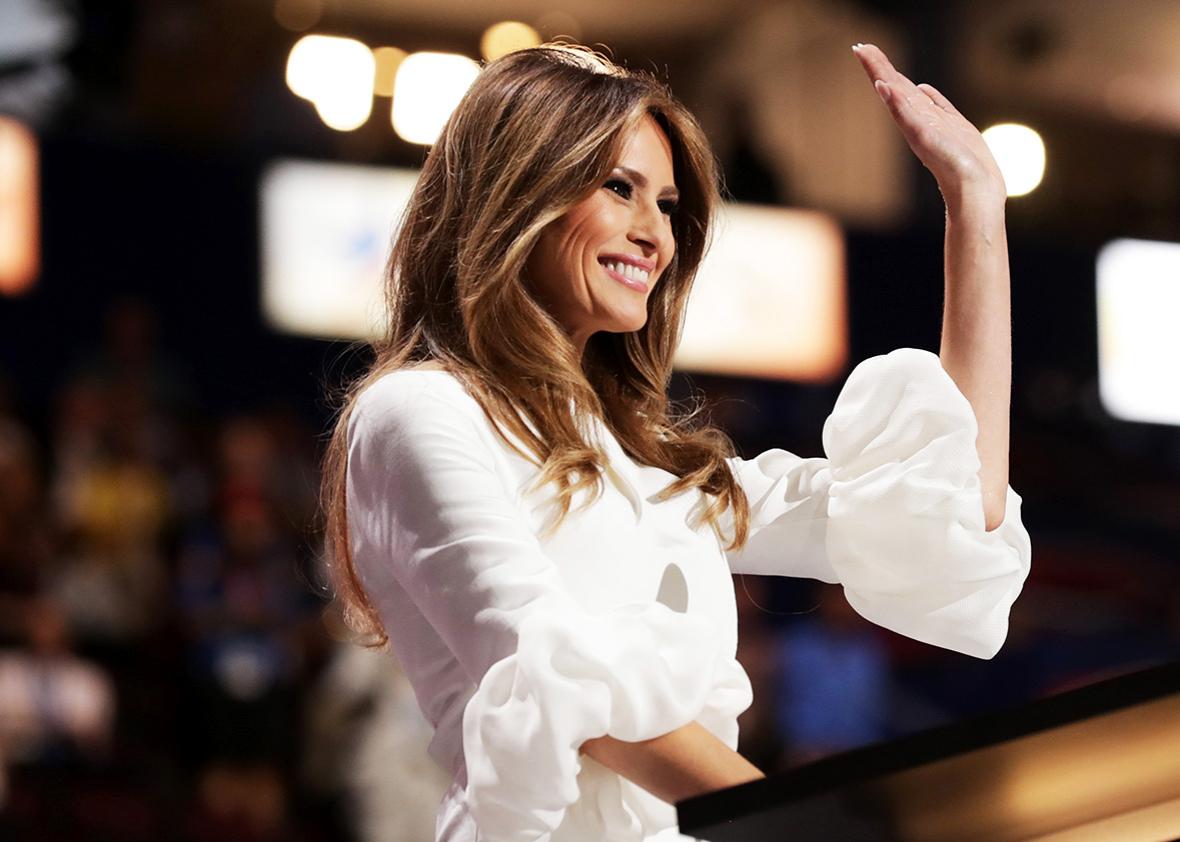
Chip Somodevilla/Getty Images
On Th, Politico published a report on inconsistencies in Melania Trump'south and Donald Trump's accounts of Melania'due south immigration to the The states. While examining Melania's claim that she would return to Europe every few months to renew an H-1B temporary work visa, as required by law, Politico's reporters made an interesting aside (accent mine):
Trump's tale of returning to Europe for periodic visa renewals is inconsistent with her property an H-1B visa at all times she was living in New York—even if it was the lesser-known H-1B visa specifically designed for models—said multiple immigration attorneys and experts.
Trump'southward quondam amanuensis, Paolo Zampolli, has since told the Associated Press that he did, in fact, secure her an H-1B visa for models. Additionally, Michael Wildes of Wildes & Weinberg, the law firm representing Trump Models, independently told Slate that she obtained a modeling H-1B. Those who are non deeply familiar with our labyrinthine immigration system might exist left scratching their heads. The H-1B, subsequently all, is typically associated with technically skilled workers—computer geeks and the like. How could Trump have gotten one for modeling?
Easily, it turns out. Only Politico'south characterization of the modeling H-1B, unglamorously called an H-1B3, elides the fact that the creation of the H-1B3 was an accident—one that sheds some light on our convoluted immigration laws.
The story starts with the Clearing Human activity of 1990, the largest overhaul of immigration policy the land had seen in at least 25 years. The Immigration Act boosted the national immigration quota by 40 percentage, instituted a slew of other changes and reforms, and created the H-1B temporary visa plan for employers hoping to hire strange workers in certain specialized industries. Those employers had previously done so under a broader H-1 visa, for which fashion models had qualified.
But models weren't shifted over to the new H-1B category, which was designated for highly skilled workers such equally those in the tech manufacture and scientists. Nor were they shifted over, with the exception of a few supermodels, to the new O-i visa category that was broadly designated for famous people of all kinds: athletes, actors, and individuals of "boggling ability" in full general. To evidence "extraordinariness" nether the O-1, applicants had to provide box part receipts, awards, and other tokens of fame and proficient fortune; ordinary tear sheets—the published photos and ads that make upward any model's portfolio—weren't included on that list. Congress, information technology seemed, had simply forgotten almost modeling entirely.
Modeling agencies panicked and claimed the new law would force the industry's leaders in America to pack upwardly and head for Europe. Merely salvation came the post-obit yr in the form of an amendment sponsored past Ted Kennedy of technical fixes to the 1990 law he had introduced. The trouble was solved by simply adding models, incongruously and a bit hilariously, to the H-1B program by style of the H-1B3, designated for models "of distinguished merit and power." Every bit a event, fashion models today compete with privately employed engineers, physicists, and programmers for the same 65,000 H-1B slots available each year. This is despite the fact that modeling doesn't require a college degree or technical training, as all other H-1B qualifying occupations must. Although models business relationship for a vanishingly small proportion of applicants, an analysis from Bloomberg in 2013 shows that their low numbers as well mean models are much more probable to become their H-1B applications approved than the skilled workers for whom the visa was actually created, such as programmers:
Fashion models are almost twice as likely to get their visas equally estimator programmers, by 1 rough measure out. There were 478 initial applications made for fashion models in 2010, co-ordinate to U.S. Labor Department information compiled by Bloomberg. The U.South. Citizenship and Immigration Services approved 250 visas for models. More than 325,000 H-1B petitions were filed for computer-related occupations; nearly 90,800 visas were distributed to foreign data-technology workers …
It's an odd state of affairs and one that lawmakers have tried to gear up. In 2008, for reasons that may or may not be clearer now, Rep. Anthony Weiner, a New York Democrat, launched a pocket-sized crusade to bring more foreign models into the state amid of a flurry of activeness in Congress on immigration reform. Specifically, he sponsored a bill that would take shifted models over to O-1 visas and given them a special quota of effectually one,000 visas a year.
The bill would've satisfied both supermodels and startups and even attracted bipartisan support. Rep. Lamar Smith, a Republican immigration hardliner from Texas, told the Los Angeles Times that he could see Weiner, then unmarried, "in a posh downtown New York Metropolis hotel celebrating the passage of this bill surrounded by hundreds of energized, wildly ecstatic fashion models. And y'all know for a fact he'southward going to accept an almanac celebration. It'southward most too much to bear." Smith backed the bill anyway, and it passed a commission vote. But the neb went nowhere from in that location, and the H-1B3 program remains unchanged today, although exceptionally famous models tin can still get O-ane visas instead.
Today, models who seek H-1B3 visas can submit materials to U.S. Citizenship and Immigration Services and cross their fingers that their tear sheets provide sufficient proof of "distinguished merit," which, obviously, tin can be hard to measure.
"The challenge they confront in this realm is trying to plant through an objective metric that they're entitled to distinction," attorney Michael Wildes says. "Sometimes it'due south hard for united states to establish a strong narrative. We never huff or puff, only we sometimes have the model wait to develop a stronger brand earlier the application."
Applying models can at least accept condolement in the fact that the people evaluating their tear sheets won't be unfashionable bureaucrats who are clueless well-nigh the manufacture. Wildes says that U.S. Citizenship and Immigration Services trains evaluators on how to judge a model's application.
In any case, the H-1B3 visa offers a reminder of how jury-rigged and provisional the American immigration arrangement truly is, and it can hardly be a surprise, to Donald Trump or anyone else, that some choose to break the law rather than piece of work through the patchwork of visas and regulations in place. We've synthetic a organization that has served broad categories of people poorly and inconsistently, whether they've called to come up in through a standard queue or a catwalk.
Read more Slate coverage of the 2016 campaign.
0 Response to "How Fashion Models Get Visa to Work in the Us"
Post a Comment