The Dandy and the Failure of Men's Fashion
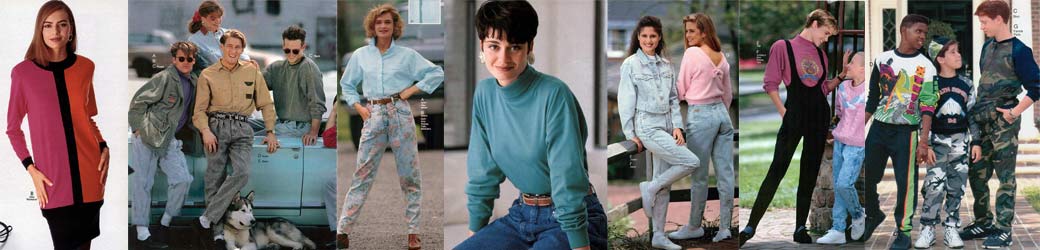
Fashion in the early 1990s was mostly loose fitting and colorful. Unless you were going for the grunge expect, then color was the enemy.
Who remembers pegging Skidz pants bought from Merry Go Circular? We had to wear Air Jordans, too. Our t-shirts were large and our shorts were extra long.
Tapered pants were a large deal. If they weren't tapered, then y'all had to taper them yourself with a fold and a couple flips.
Boys and girls both wore baseball caps in many different ways. Mullets were stylish for a couple years and every sweater had a turtleneck under it.
But and so grunge happened. Suddenly every thrift shop in boondocks couldn't proceed a flannel shirt in stock to save their backs. Teens were excavation through dad'due south box of erstwhile clothes to get their easily on some authentic hole-ridden jeans to habiliment over top of their long john stockings.
Barbers nearly went out of business organization because no one under 17 got their pilus cut any more (OK, we may be exaggerating merely a little.)
Too in the early nineties fashions worn by hop hop artists were becoming increasingly mainstream. And because of the growing popularity of hip hop music among the suburban customs, urban styles were seen everywhere, not just in the big city.
By the late 1990s hip hop mode was arguably the most popular among young people.
Starting in the mid-90s, industrial and war machine styles crept into mainstream mode. People were finding any way to make a style accompaniment out of a piece of machinery. Camouflage pants were ironically worn past anti-war protesters.
By the late 90s, rave culture swept through and people were looking for dress that were more glamorous again. The grungy styles of the early nineties were old chapeau. Looking rich was cool again. Name make designers were back in a big way.
Interestingly enough, late 90s clothing styles are not also drastically different than they are today. In the 1990s, musicians had a much greater influence on what young people wore than designers. All a kid in Kansas had to do was turn on MTV for the latest due east and west coast styles of the moment.
For significantly more detail nigh a certain yr in 1990s mode, click on the plus sign next to the year beneath.
QUICK REFERENCE LINKS
1990s Mode Timeline
1990 | 1991 | 1992 | 1993 | 1994 | 1995 | 1996 | 1997 | 1998 | 1999
1990s Way: In-Depth Profiles
1990s Fashion: Pictures
In-Depth 1990s Fashion Profiles
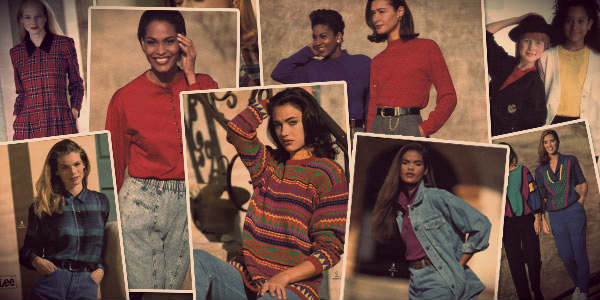
1990s Way: Women & Girls »
1990s fashion for women is embarrassing to some, awesome to others. From teased hair to turtlenecks, check out our picture gallery of nineties mode!
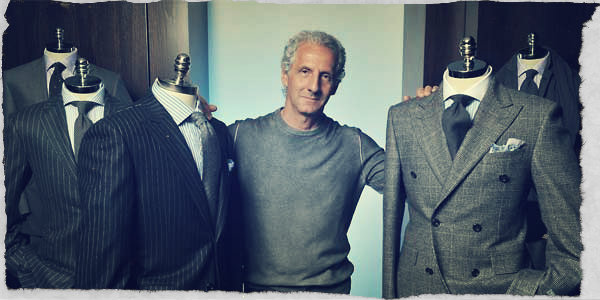
Joseph Abboud: Way Designer Facts, History & Pictures »
Joseph Abboud focuses on lifestyle as much as blueprint. Even since his Ralph Lauren days, he has given both men and women clothes they can wear every day.

Badgley Mischka: Mode Designer Facts & History »
Designers Marker Badgley and James Mischka combined their talents to create women's vesture that radiates youthful confidence. They made elegance attainable.
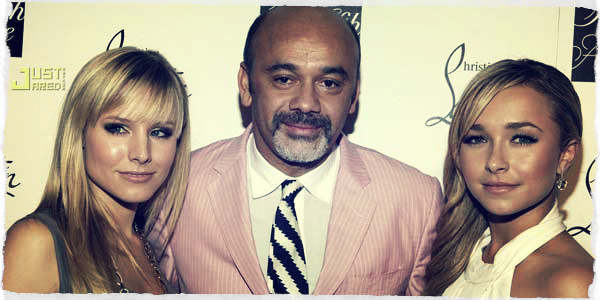
Christian Louboutin: Fashion Designer Facts & History »
Christian Louboutin has go the premier shoe designer in the 21st Century. No cherry-red carpet is complete without a pair of Louboutin stilettos on it.
Fashion in 1990
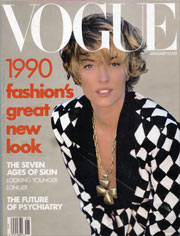
1990 Fashion: Faddy Mag Cover
In 1990, recession-weary shoppers chose to spend coin on clothes that would stay in way as long as possible. That meant that the wild shapes and colors of recent years needed to be toned downwardly.
The jacket remained the key to daytime dress. A trend setter in the jacket trend was Chanel, who introduced loose versions of the famous Chanel jacket slit vertically at the hem. Some were vivid colors like hot pink, tangerine and white. Other leaders were Giorgio Armani, and Calvin Klein.
The biggest divergence in 1990 style was an explosion of colour, with alarming arrays of bright yellow, orange, cherry-red, purple and greenish. Neon bright colors could exist obvious as the chief color of a pair of pants — or they could be subtle every bit the color of a pair of shoestrings.
Brocade, embroidered satins and laces were of import, but the near popular way of eveningwear was the slender blackness dress, worn quite brusque with black stockings and high-heeled shoes.
In the winter of 1990 the short, swingy coat was worn in full force. Women loved how racy the coat looked over short skirts. Casual styles, such as anoraks and parkas were prominently seen in cold-weather climates.
A revival of the involvement in made-to-lodge clothing occurred in 1990 when women realized that it wasn't more expensive than ready-to-wear clothing. This surprised many way analysts and drew other designers to New York Metropolis, following the success of Arnold Scaasi.
Fashion in 1991
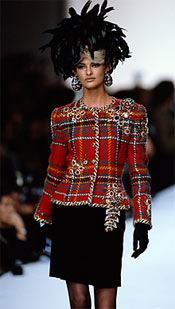
Oscar de la Renta Plaid (1991)
By 1991, the well-known and well-established designers were in their 50's and lx'south. Geoffrey Beene, regarded past many as the most prestigious designer in New York Metropolis, has been the head of his own fashion company for 28 years. James Galanos, whose headquarters is in Los Angeles, has been a mode leader for 40 years.
Designers everywhere focused on the jacket every bit the key to contemporary dressing. Denim jackets and leather biker's styles appealed to younger people. For the sophisticated woman, in that location were long, gently curved jackets from major de signers, such equally Giorgio Armani and Karl Lagerfeld of Chanel, besides as less expensive versions without
designer labels.
I wore a long, green, army style Eddie Bauer jacket.
A standard fashion for women to wearing apparel for the office was to wear one of these longer jackets over a skirt that stopped curt of the knees. But all kinds of combinations were possible, such as jackets with trousers, leggings, or tights. Jackets with shorts also gained acceptance in some areas for more than formal daytime wear, every bit women wore shorts to offices during the hot summertime weather.
For women whose lives did not require formal dressing, including most students, T-shirts, sweat shirts, sweat pants, and jeans were the rule. Calvin Klein, Donna Karan, and other major designers introduced special jeans collections to appeal to these women and to
those who dressed informally during the weekend.
The special weekend-wear category was not express to basic blue jeans. Designers offered white and black jeans, stone washed, and beige styles. Cutoffs and jackets to match appeared in stores, as did overalls and skirts, both brusk and long.
Brim length moved into fashion consciousness again. Since 1988, short skirts were considered the standard, though many women wore their hems at midcalf. Designers everywhere in the fashion world introduced some longer styles into their collections. The consensus among fashion leaders was that long and brusque hemlines could coexist. Many designers claimed that they already did.
Plaids made a strong fall mode entry, spurred past Oscar de la Renta's suits, coats, and even furs worked in plaid patterns. They were shown at his Paris debut in March. De la Renta was the first American designer to join the French gear up-to-wear shows.
Mode leadership all the same remained in the hands of ready-to-clothing designers in 1991. But the couture, or made-to-gild branch of the fashion industry, based in Paris, showed renewed vigor. Designers such every bit Lagerfeld at Chanel, with his denim and motorcycle jackets, and Claude Montana, who introduced space age looks at the House of Lanvin, revitalized couture fashion during the twelvemonth. Merely all the couture houses also had ready-to-wear collections that were less expensive than fabricated-to-social club clothes.
Fashion in 1992
Fashion in 1992 was and so subdued that the most popular color was black. One other major change was the lengthening hemline.
Due to a slow economy, designers that emerged in 1991 didn't have off as expected. The two exceptions being Isaac Mizrahi and Marc Jacobs, who were widely accustomed into the fashion world in 1992.
For women who didn't care so much for skirts, there were ever pants. The pants resembled the early 1970s styles, with flaring kick cuts. Pants were worn at work, at home or out to the movies.
Animal prints were in loftier need in 1992. Many women decided non to purchase fur coats unless they were made of constructed materials. Prints suggesting tigers, giraffes and leopards turned up in everything from t-shirts to shoes to purses to dresses.
Casual weekend fashions were emphasized in collections by Calvin Klein and Donna Karan. These collections included denim separates, long and short skirts, sweaters and pants.
Yves Saint Laurent historic his 30th year in the way industry. with a spectacular fashion bear witness at the opera de la Bastille in Paris. Adolfo quietly passed his 25th anniversary without fanfare.
Valentino hosted his retrospective show to New York City in September, exhibiting clothes of his design that spanned 30 years.
Fashion in 1993
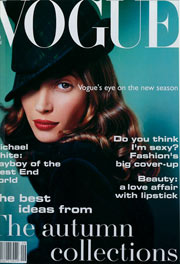
1993 Manner: Sept. Vogue Magazine Comprehend
In 1993, at that place was a cursory flurry of interest in bong-bottom pants and platform shoes. Simply virtually fashions presented by the world's leading designers fizzled and failed to affect the ready-to-wear market place.
For example, tiptop designers had successfully reintroduced the long skirt in 1991, only in 1993 a significant segment of the style-conscious public rejected the long brim. Stored reported that dogie and ankle-length skirt sold well, but women just weren't wearing them. Women frequently chose short skirts or pants instead.
It was in 1993 that the way world began to lose touch on with what women actually wanted to habiliment. The extravagance and polish of fashion shows approached the best Broadway production. Some designers introduced styles as various as aboriginal Hellenic republic and Victorian England, but these clothes were unsuited to the electronic age.
Designers turned to top models such as Kate Moss, Claudia Schiffer and Christy Turlington, only observers noted that the top models wait great in anything, but "normal" women wearing the same style plant it difficult to attain the aforementioned effect.
A surprising success in Fall 1993 was the long, blackness, fitted wintertime coat.
Teenagers everywhere were seen growing long hair and wearing tattered flannel shirts a la Pearl Jam and Nirvana. Fifty-fifty the preppiest kids were sporting the new "grunge" await. Parents everywhere shook their heads in disbelief, thinking they had successfully shook the sloppy 1970s style.
The brawl cap was a popular accessory in 1993. The bill was typically bent modestly and the bill rested above the hairline.
Large, fat cotton t-shirts had completely replaced the skinny, tight blended t-shirts. In 1993, 80s t-shirts were not ironic, just out of mode.
Green canvas, military fashion jackets were commonly seen, and Nike Air Jordans were the tennis shoe of selection.
Fashion in 1994
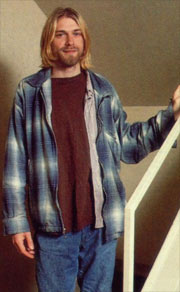
1994 Mode: Kurt Cobain and the grunge style
In early 1994, the "grunge" style had completely taken over the American fashion world. A manner derived from wearing apparel worn by Seattle rock musicians, grunge was an assortment of jackets, vests, sweaters, skirts, scarves, and footwear that resembled hiking boots.
Marc Jacobs developed a grunge collection. Gianni Versace did too, but women establish themselves hard pressed to pay designer prices for what they thought resembled second-hand wearing apparel. While grunge remained popular with the younger crowd in 1994, women over 30 were unimpressed.
By the finish of 1994, women were wearing high heels and dresses fabricated of satin, metallic or other loftier smooth fabrics. Feathers and fringe, chaplet and sequins adorned dress that hugged the body. 1972 glam was dorsum!
Comfort persisted in the clothes women wore in their reanimation. Tights fabricated of spandex, t-shirts and loose sweaters dominated the weekend.
Women still found the suit to exist the most useful way to clothes for the increasingly faster-paced mod world. Giorgio Armani figured out ways to tailor wearing apparel that both men and women loved.
As Yves Saint Lauren constitute out, using real fur was an invitation for passionate protests from animal rights activists. During his kickoff visit to the U.S. in 12 years, he was greeted by angry picketers who took upshot with the fox trim on his jackets that were on display at a New York Metropolis Saks Fifth Avenue store.
Fashion in 1995
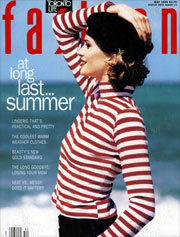
1995 Fashion Magazine Cover (May)
Men and women did not blindly follow fashion designers in 1995. Sure, they yet dressed up for weddings and special events, merely for the most part everyone wore casual dress. T-shirts were seen everywhere.
Women ignored the supposed hemline of the times and interchanged brusk and long skirts when they felt like information technology. Women were less interested in provocative wear, trading in sheer fabrics and tall heels for comfort and freedom. Some women looking to enhance their curves, however, were quite fond of the button-upwardly bra.
The American fashion buying public had all but lost interest in high manner. Designers spent millions on lavish shows, parading supermodels around in fashions that no common woman would exist able to afford, let alone wear. To the boilerplate woman, way shows became something of an amusing novelty and not actually something to be taken seriously.
Expensive labels gave way to applied ones like The Gap. Many price-cutting women were getting their clothing from Wal-Mart, K-Mart and Caldor. They would frequently "cross shop", pregnant they would get 1 or ii pieces in an upscale shop, then supplement it with a cheaper pair of jeans or a sweater.
Near every designer that fabricated a profit focused on lower-priced styles. Geoffrey Beene made lower-priced styles for men and women that were sold in 135 shopping malls.
The "dress for success" style that dominated previous decades practically disappeared in 1995. Increasingly, companies were offering "casual Fridays" in which employees were allowed to wear jeans to work.
And although sportswear had been effectually for fifty years, designers like Calvin Klein, Donna Karan and Ralph Lauren were still finding means to put a new twist on an erstwhile plot.
Fashion in 1997
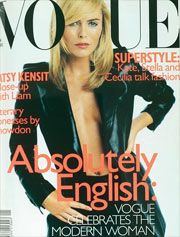
1997 Way: Vogue January. Magazine Cover
Pop fashions in 1997 included casual dress at the office and a return to the styles of the 1970s.
Men, women, children — near everyone took to wearing baseball caps in 1997. Bending the bill was necessary, but information technology was too common to see people wearing them backwards, or even sideways (in an ironic sort of way).
Monochromatic shirt and tie combinations kept men'southward article of clothing subtle. But shut-fitting knit tops, flared pant legs and tall platform shoes reminded us of an era ii decades prior.
The fashion industry was shocked past the senseless murder of Giovanni Versace on July 15.
Involvement in fashion, which had peaked in the 1980s, had been waning for several years. To restore that interest, designers created styles to fit an increasingly relaxed era.
For women in the workplace, the pants adapt replaced, once and for all, the traditional jacket/skirt philharmonic.
Sportswear like casual jackets, t-shirts, sweatshirts and lawn tennis shoes (ie: sneakers, trainers) were acceptable for many occasions.
Fifty-fifty for formal settings, elaborate dresses were inappropriate. Women chose the "little black dress", with or without subtle embroidery. Luxury was expressed quietly, with precious fibers like silk and cashmere.
Surprisingly, fur was making a comeback, despite abiding anti-fur protesting. Simply it wasn't the full length coat of yore, the fur was used more for trim, handbags and coincidental uses.
Style in 1999
The mode world's focus in the terminal yr of the millennium was on mergers and acquisitions much more than than fabrics.
Upwards until the 1980s, smaller fashion firms were able to stay in business by beingness more flexible and being able to react chop-chop to the newest trends. Since and so nonetheless, these companies had struggled to keep up and many fashion boutiques merged into huge corporate enterprises.
The biggest acquisition of 1999 featured Gucci, who was almost purchased by Louis Vuitton. Gucci ended upwardly going to Pinault-Printemps-Redoute instead.
In the U.South., Kasper of New Jersey bought the Anne Klein Company and Estee Lauder swept upwardly Stila, an emerging cosmetics company.
Sportswear remained the dominant choice worldwide. Some sportswear designers tried dressier looks to little fanfare. Women wore fitted tops over t-shirts or tank tops, while jeans featured embroidery and other decorations.
In lodge to spice up their sportswear, women were turning to colorful accessories. Brightly colored handbags, glittering hair ornaments and jewelry, such as arm bands and bracelets had fabricated a strong comeback.
The Pashmina shawl, made from the finest cashmere on the planet, was a huge success. It came in bright pastel shades and was worn over casual clothes besides as evening wear. Fifty-fifty thought prices of this shawl could easily top $100, they even so won worldwide credence equally a luxury way item.
With the impending turn-of-the-millennium parties approaching, mode designers put all of the efforts into evening wear. Dresses were sleek, in all lengths, made of luxurious fabrics. The were adorned with embroidery and beads.
By the end of the century the business suit in the office had all but vanished. Men and women both were embracing the new "business casual" look, not just for employee comfort, but as a tactic to recruit younger generations.
Supermodels no longer carried the same sway that they used among the fashion manufacture. Instead, movie stars were the trendsetters. Stars such every bit Gwyneth Paltrow and Nicole Kidman were featured more than prominently in style magazines by 1999.
1990s Women's Fashion Pictures
CLICK IMAGE TO Enlarge
1990s Men's Fashion Pictures
CLICK IMAGE TO ENLARGE
0 Response to "The Dandy and the Failure of Men's Fashion"
Post a Comment